
A unified revenue engine puts prospecting, CRM, conversations, enablement, forecasting and commissions on one shared data model, so every team works from the same account, deal and payout record. It replaces the fragmented revenue technology stack, where each tool holds its own copy of the truth. Revenue teams are switching because reconciliation eats hours every week, and because AI agents can only act on data they can see.
Key takeaways
- Fragmented stacks create competing versions of the same number. Integrations move the reconciliation work; they do not remove it.
- A unified revenue engine has one account, one opportunity, one forecast and one commission record that every module shares.
- AI makes unification urgent. One agent can act across the whole deal only when the whole deal lives on one record.
- You do not have to rip and replace. Teams can start as an overlay on the CRM they already use.
The QBR deck is due at noon, and the night before, the CRO asks a fair question: which campaigns produced the deals we closed this quarter, and what did we pay out on them?
Marketing pulls campaign data from the automation platform. Sales ops pulls closed-won deals from the CRM. Finance pulls commissions from the comp system. The three exports disagree on deal count, on dates and, in two cases, on which account a deal belongs to. By 11:40 somebody has built a fourth spreadsheet to reconcile the other three, and the slide goes out with a footnote.
Nobody in that meeting did anything wrong. Each team owns an accurate version of a different system. That is the real problem, and it is why I believe the next generation of revenue technology will be built as a unified revenue engine.
How did revenue teams end up with a stack nobody planned?
For fifteen years we bought revenue software one job at a time. One tool for prospecting data, another for sequencing, another for call recording, one for forecasting, one for commissions, and a CRM sitting in the middle. Every purchase made sense on its own, and every vendor solved a real problem.
What no single purchase accounted for was the cost between the tools. Each one brought its own data model and its own definition of an account. So we added integrations to move copies of the data around, and then we hired people to keep the copies in agreement.
I saw this up close running B2B sales. More tools, more logins, more places to type, and a customer who looked slightly different in each one.
What does a fragmented revenue tech stack really cost?
The cost of a fragmented revenue tech stack rarely shows up on an invoice. It shows up in how people spend their week.
- Reps move context between tabs instead of talking to buyers.
- Managers coach from data that is already a few days old.
- RevOps spends hours reconciling exports before every board meeting and quarterly business review.
- Finance and sales argue about whose number is right, when both are correct for the system each one uses.
Gartner research found that 49% of sellers feel overwhelmed by the technology they use, and that sellers in that group are 43% less likely to hit quota. Technology was supposed to add productivity. Past a certain point, it adds weight.
Why don’t more integrations and more hires fix the problem?
The usual response to fragmentation is more plumbing: another connector, a data warehouse, a RevOps hire who owns the sync.
These investments help, and I would not tell anyone to skip them. But they move the reconciliation somewhere else instead of removing it. The fourth spreadsheet becomes a dashboard, and the footnote comes along with it. The underlying structure, where every system holds its own version of the truth, stays exactly as it was.
Mark Stevens, our CMO, describes this well in his book GTM. He frames go-to-market as five connected pillars: Market Position, Pipeline Development, Customer Acquisition, Customer Retention and Growth, and Winning Culture. A weakness in one pillar shows up as a symptom in another. Yet most revenue stacks are built as if those pillars had nothing to do with each other.
What is a Unified Revenue Engine?
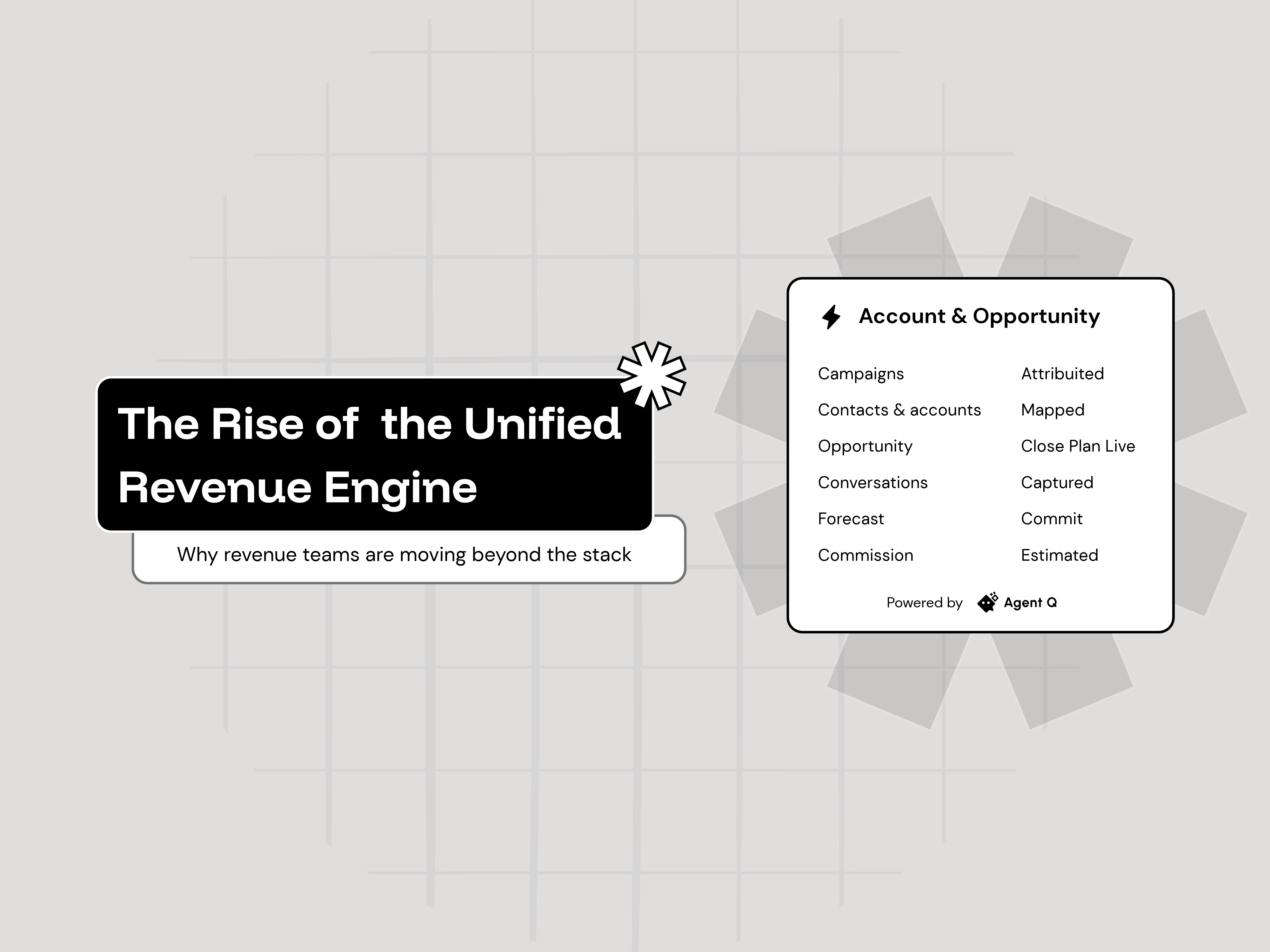
A unified revenue engine is a single revenue platform where prospecting, CRM, conversations, enablement, forecasting and commissions all read and write one shared data model. There is one account, one opportunity, one forecast and one commission record, so every team sees the same numbers without syncing or reconciling copies.
That is different from integrating six tools. In an integrated stack, copies of data travel between systems. In a unified engine, nothing is copied. Six modules work on the same record:
- Campaigns: programs, account-based marketing and sequences
- Contacts and accounts: people, buying roles and intent
- Opportunities: the deal, the qualification and the close plan
- Conversations: email, calls, meetings and notes
- Forecasting: the roll-up, the board view and attainment
- Commissions: estimates, calculation and payout
A campaign touch, a recorded call, a stage change and a payout all attach to the same row. Marketing attribution and closed-won revenue cannot disagree, because they are the same data.
| Integrated revenue stack | Unified revenue engine | |
| Where data lives | Copies synced across 6+ tools | One record every module shares |
| Definition of an account | A different one in each tool | One shared definition |
| Reconciliation | Manual exports, warehouse or RevOps time | Not needed |
| What AI can see | Each assistant sees one slice | One agent sees the whole deal |
| “Which campaigns drove closed-won revenue?” | Three exports and a spreadsheet | One query |
The CRO’s question the night before the QBR now has a single answer.
Why does AI make a unified revenue engine urgent?
This matters more now than it did five years ago, because revenue teams are putting AI to work on their data.
An AI agent can only reason over what it can see. In a fragmented stack, every assistant sees one slice: the CRM assistant sees deal fields, the call tool’s assistant sees transcripts, and none of them sees the procurement email or what a discount would do to a rep’s commission. The rep ends up as the integration layer, asking the same question in four places.
When the whole lifecycle lives on one record, a single orchestrating agent can work across all of it. That is how we designed Quantum Heaps. Agent Q routes a lead, flags a stalled deal, prepares a meeting brief and estimates a commission, because it sees the whole deal. The rep still owns the relationship and the judgment calls. The agent handles the work of moving information around.
Case study: how Ingenx went from six systems to one
Before Ingenx moved to Quantum Heaps, its leads, commission structures and enablement each lived in a separate system. Ingenx is an IT services firm with teams in India, the UAE, Kenya, Sri Lanka, the US and the UK. Its Founder and CEO, Gaurav Agarwal, described the old setup in one word: disjoint. Pipeline reviews meant hunting through documents and folders across six countries, and the forecast was met with skepticism.
Ingenx moved its leads, open pipeline and closed deals onto one record. The results:
- 6 disconnected systems → 1 unified revenue engine
- Weekly sales review: from hours of consolidated reporting to 30 minutes
- Forecast accuracy: from 58% to 87% in 90 days
In Gaurav’s words, “We now have a forecast which is an actual forecast.”
Licence savings are part of the story, but the bigger change is how people spend their week. Managers coach from current deal data. RevOps designs territories and plans instead of reconciling exports. Finance and sales look at the same bookings with the same timestamps.
Do you have to rip and replace your CRM?
No. Fear of migration keeps many teams on systems they have outgrown, and that fear is rational.
Teams that are not ready to replace their CRM can start with Quantum Heaps as an overlay on the CRM they already use, with real-time two-way sync. The existing system stays the system of record while the team proves the value on its own deals. When the team is ready, it brings over what matters and cuts over one group at a time. Unification does not require a big-bang project.
How to audit your revenue stack in under an hour
You can measure how fragmented your own stack is without buying anything. Try this next Monday:
- Trace one closed-won deal from first touch to payout, and count how many systems hold a version of it.
- Ask RevOps how many hours a month go into reconciling data, and put a dollar figure on it.
- Write down the three questions your CRO asks most, and mark the ones that need more than one system to answer.
Most leaders are surprised by the result.
The question to leave with
The best revenue stacks of the next decade will not be judged by how many tools they contain. They will be judged by how much complexity they remove, and by whether every team looks at the same version of the truth.
So I will ask you directly: which number in your business has the most competing versions, and who owns the spreadsheet that settles it?
See how the Unified Revenue Engine works on your own pipeline. Book a demo →
FAQ
What is a unified revenue engine?
A unified revenue engine is one platform where prospecting, CRM, conversations, enablement, forecasting and commissions share a single data model. Every team works from the same account, opportunity, forecast and commission record, so numbers never need reconciling across tools.
How is a unified revenue engine different from an integrated tech stack?
An integrated stack copies data between separate tools; a unified revenue engine stores it once. With integrations, each tool keeps its own version of an account and syncs changes. In a unified engine, every module reads and writes the same record.
Why are revenue teams consolidating their sales tech stack?
Revenue teams consolidate because fragmented tools cost time, trust and quota. Reps switch between tabs, RevOps reconciles exports before every review, and Gartner found that sellers overwhelmed by technology are 43% less likely to hit quota.
How does AI work in a unified revenue engine?
AI works better in a unified revenue engine because one agent can see the entire deal. In Quantum Heaps, Agent Q reads emails, calls, pipeline and commission data from one record, so it can route leads, flag stalled deals, prepare meeting briefs and estimate payouts.
Do I need to replace my CRM to use a unified revenue engine?
No. Quantum Heaps can run as an overlay on your existing CRM, such as Salesforce or HubSpot, with real-time two-way sync. Your CRM stays the system of record until you choose to move teams over, one group at a time.
How can I tell if my revenue stack is too fragmented?
Trace one closed-won deal from first touch to payout and count how many systems hold a version of it. If the answer is more than two, or if your CRO’s top questions need several exports to answer, your stack is fragmented.
About the author: Harsh Panwar is the Founder and CEO of Quantum Heaps, the Singapore-headquartered AI-native revenue technology company building the Unified Revenue Engine, powered by Agent Q. LinkedIn.